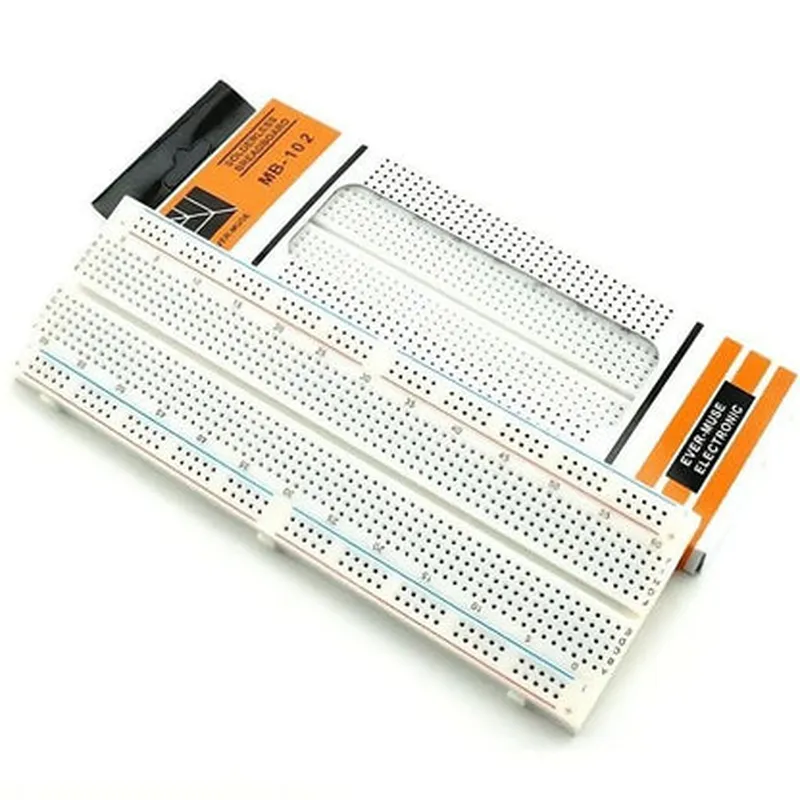
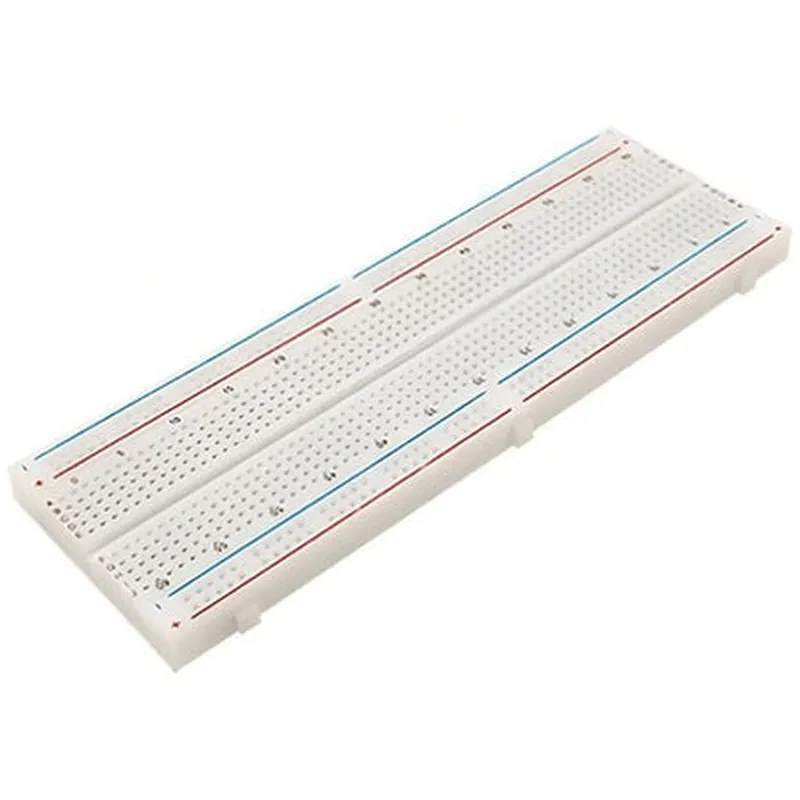
MB102 830 Points Solderless Breadboard Documentation
The MB102 830 Points Solderless Breadboard is a versatile and convenient platform for prototyping and testing electronic circuits. It provides a large surface area for building and connecting various electronic components, making it an essential tool for IoT developers, hobbyists, and students.
830 tie points, including 300 tie points in the middle and 265 tie points on each side
 Solderless breadboard with 0.1" spacing and 1.37" mounting holes
 Self-adhesive backing for easy mounting
 Compatible with a wide range of electronic components, including resistors, capacitors, ICs, and more
Here are three code examples demonstrating how to use the MB102 830 Points Solderless Breadboard in various contexts:
Example 1: Simple LED Circuit (Arduino)
In this example, we will connect an LED to a digital pin on an Arduino board using the MB102 breadboard.
1 x Arduino Board (e.g., Arduino Uno)
 1 x LED
 1 x 220 Resistor
 1 x MB102 830 Points Solderless Breadboard
 Jumper wires
Code:
```c
const int ledPin = 13;  // Choose a digital pin on the Arduino board
void setup() {
  pinMode(ledPin, OUTPUT);
}
void loop() {
  digitalWrite(ledPin, HIGH); // Turn the LED on
  delay(1000);
  digitalWrite(ledPin, LOW);  // Turn the LED off
  delay(1000);
}
```
Connection:
1. Connect the LED to digital pin 13 on the Arduino board using a jumper wire.
2. Connect the 220 resistor to the LED's anode (positive leg) and the breadboard's power rail.
3. Connect the LED's cathode (negative leg) to the breadboard's ground rail.
Example 2: I2C Communication with a Sensor (Raspberry Pi)
In this example, we will connect a temperature sensor (e.g., DS18B20) to a Raspberry Pi using the MB102 breadboard and read temperature data using I2C communication.
1 x Raspberry Pi
 1 x DS18B20 Temperature Sensor
 1 x MB102 830 Points Solderless Breadboard
 Jumper wires
Code:
```python
import smbus
import time
# Initialize I2C bus
bus = smbus.SMBus(1)
# DS18B20 address
address = 0x48
while True:
    # Read temperature data from the sensor
    data = bus.read_i2c_block_data(address, 0x00, 2)
    temperature = data[0] + (data[1] / 256.0)
    print("Temperature: {:.2f}C".format(temperature))
    time.sleep(1)
```
Connection:
1. Connect the DS18B20 temperature sensor to the breadboard.
2. Connect the sensor's VCC pin to the Raspberry Pi's 3.3V pin using a jumper wire.
3. Connect the sensor's GND pin to the Raspberry Pi's GND pin using a jumper wire.
4. Connect the sensor's SCL pin to the Raspberry Pi's SCL pin (GPIO 5) using a jumper wire.
5. Connect the sensor's SDA pin to the Raspberry Pi's SDA pin (GPIO 6) using a jumper wire.
Example 3: IoT Project with ESP32 and WiFi (MicroPython)
In this example, we will connect an ESP32 board to a WiFi network and send sensor data to a cloud-based server using the MB102 breadboard.
1 x ESP32 Board
 1 x MB102 830 Points Solderless Breadboard
 1 x WiFi Antenna
 Jumper wires
Code:
```python
import machine
import network
import urequests
# Initialize WiFi
wlan = network.WLAN(network.STA_IF)
wlan.active(True)
wlan.connect("Your WiFi SSID", "Your WiFi Password")
while True:
    if wlan.isconnected():
        print("Connected to WiFi!")
        # Send sensor data to the cloud-based server
        response = urequests.get("https://example.com/iot/projects/your_project_id")
        print(response.text)
        response.close()
        machine.sleep(10000)
    else:
        print("Not connected to WiFi. Trying again...")
        machine.sleep(1000)
```
Connection:
1. Connect the ESP32 board to the breadboard.
2. Connect the WiFi antenna to the ESP32 board.
3. Connect power and ground rails to the breadboard's power and ground rails.
These code examples demonstrate how to use the MB102 830 Points Solderless Breadboard in various IoT-related projects, from simple LED circuits to more complex I2C communication and WiFi connectivity. The breadboard's flexibility and ease of use make it an ideal platform for prototyping and testing a wide range of electronic circuits.