5mm White LED (Pack of 10)


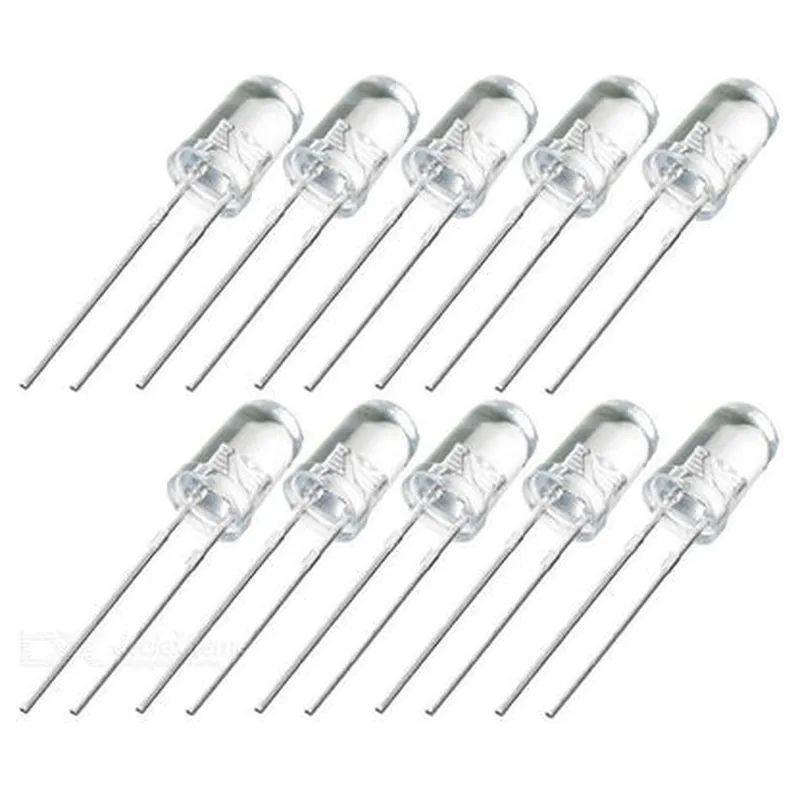
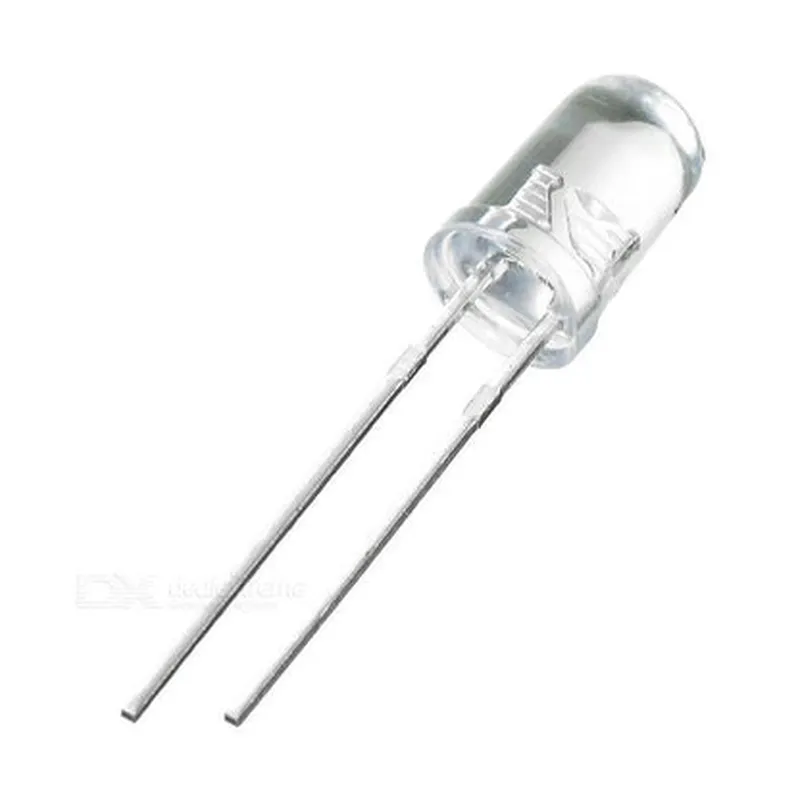
5mm White LED (Pack of 10)
The 5mm White LED is a standard, high-brightness light-emitting diode (LED) component that emits white light. The pack of 10 LEDs is ideal for various applications, including DIY projects, prototypes, and small-scale productions. This documentation provides a detailed description of the component's functionality, key features, and specifications.
The 5mm White LED is a semiconductor device that converts electrical energy into visible white light. When a forward voltage is applied to the LED, it emits light in a specific direction, making it suitable for various applications that require a localized light source.
| Forward Voltage (Vf) | 3.0-3.2V |
| Reverse Voltage (Vr) | 5V |
| DC Forward Current (If) | 20mA |
| Peak Forward Current (I fp) | 30mA |
| Reverse Current (Ir) | 10A |
| Luminous Intensity (IV) | 1.5-2.5cd |
| Dominant Wavelength (d) | 560-580nm |
| Viewing Angle (21/2) | 30 |
5mm (diameter) x 2.5mm (height)
20mm
2.5mm
The 5mm White LED is supplied in a pack of 10 pieces, each individually packaged in an anti-static bag to prevent damage during transportation and storage.
| The 5mm White LED is suitable for a wide range of applications, including |
DIY projects
Prototypes
LED indicators
Automotive lighting
Lighting fixtures
Electronic signage
Display backlighting
Handle the LEDs with care to avoid damage.
Avoid applying excessive force, pressure, or vibration.
Ensure proper soldering and handling techniques to prevent damage to the LEDs.
Follow proper safety precautions when handling electrical components.
By following the guidelines and precautions outlined in this documentation, users can ensure safe and effective use of the 5mm White LED component in their projects.
Component Documentation: 5mm White LED (Pack of 10)OverviewThe 5mm White LED (Pack of 10) is a compact, high-intensity light-emitting diode (LED) component designed for various IoT applications. Each LED in the pack has a diameter of 5mm and emits a bright white light with a wavelength of approximately 6500K. This component is suitable for a wide range of projects, including robotics, home automation, wearable technology, and more.Pinout and Technical SpecificationsAnode (Positive Leg): Long leg
Cathode (Negative Leg): Short leg
Voltage: 2.0-3.5V DC
Current: 20-30mA
Luminous Intensity: 100-150mcd
Viewing Angle: 30
Operating Temperature: -25C to +85CCode Examples### Example 1: Basic LED Control with ArduinoIn this example, we will use an Arduino Uno board to control the 5mm White LED. We will connect the LED to digital pin 13 and use the `digitalWrite()` function to turn the LED on and off.Hardware Connection:Connect the anode (long leg) of the LED to digital pin 13 on the Arduino Uno board.
Connect the cathode (short leg) of the LED to a 220 resistor.
Connect the other end of the resistor to the GND pin on the Arduino Uno board.Arduino Code:
```c
int ledPin = 13; // Choose the pin for the LEDvoid setup() {
pinMode(ledPin, OUTPUT); // Set the pin as an output
}void loop() {
digitalWrite(ledPin, HIGH); // Turn the LED on
delay(1000); // Wait for 1 second
digitalWrite(ledPin, LOW); // Turn the LED off
delay(1000); // Wait for 1 second
}
```
### Example 2: PWM Dimming with Raspberry Pi (Python)In this example, we will use a Raspberry Pi to control the 5mm White LED using Pulse Width Modulation (PWM). We will connect the LED to GPIO pin 18 and use the `RPi.GPIO` library to control the LED's brightness.Hardware Connection:Connect the anode (long leg) of the LED to GPIO pin 18 on the Raspberry Pi board.
Connect the cathode (short leg) of the LED to a 220 resistor.
Connect the other end of the resistor to the GND pin on the Raspberry Pi board.Python Code:
```python
import RPi.GPIO as GPIO
import timeGPIO.setmode(GPIO.BCM)
GPIO.setup(18, GPIO.OUT) # Set GPIO pin 18 as an outputpwm = GPIO.PWM(18, 50) # Create a PWM object with a frequency of 50Hz
pwm.start(0) # Start the PWM with a duty cycle of 0%while True:
for dc in range(0, 101, 5): # Dim the LED from 0 to 100%
pwm.ChangeDutyCycle(dc)
time.sleep(0.1) # Wait for 0.1 seconds
for dc in range(100, -1, -5): # Dim the LED from 100 to 0%
pwm.ChangeDutyCycle(dc)
time.sleep(0.1) # Wait for 0.1 seconds
```
Note: Make sure to install the `RPi.GPIO` library and import it correctly before running the code.These examples demonstrate the basic usage of the 5mm White LED (Pack of 10) in various IoT applications. You can adapt these examples to suit your specific project requirements.