Stufin
Home Quick Cart Profile

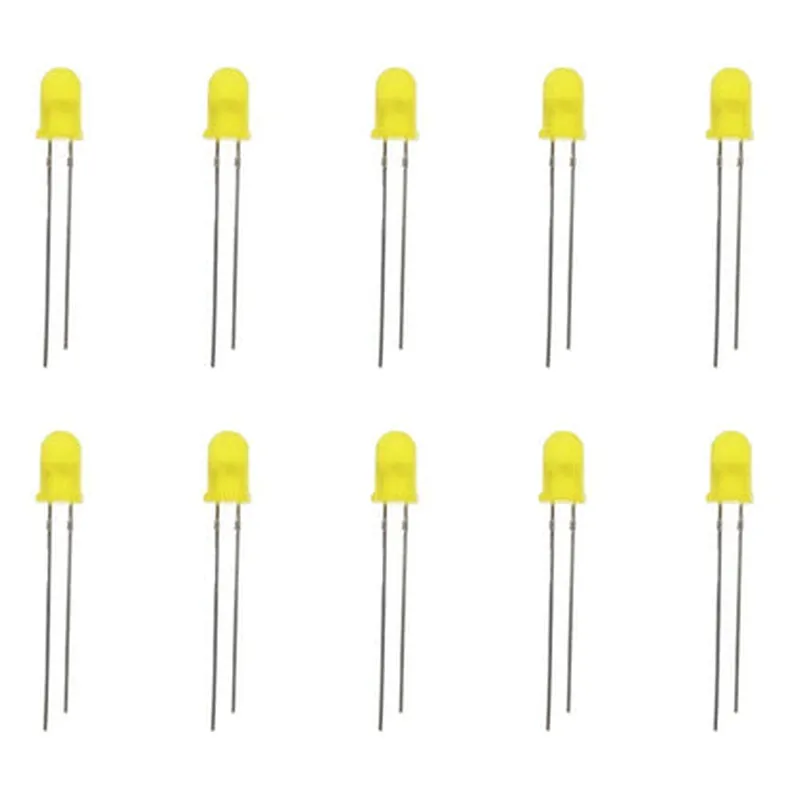
5mm Yellow LED(Pack of 10)

Buy Now on Stufin

Component Name

5mm Yellow LED (Pack of 10)


Description

The 5mm Yellow LED (Pack of 10) is a light-emitting diode (LED) component that emits yellow light when an electric current passes through it. This LED is designed to be used in various electronic projects, circuits, and applications where a bright, yellow visual indicator is required.
Functionality

The primary function of this LED is to convert electrical energy into light energy. When a sufficient voltage is applied across the LED's anode and cathode terminals, it releases energy in the form of yellow light. The LED can be used as an indicator, backlight, or for aesthetic purposes in various applications, such as

Status indication (e.g., power on/off, alarm, or warning)

Backlighting for LCD displays, keyboards, or other devices

Decorative lighting for cars, homes, or other environments

Signaling or notification in industrial, medical, or consumer electronics

Key Features

  • Size: 5mm diameter, making it suitable for compact and space-constrained designs.
  • Color: Yellow, with a wavelength of approximately 590-595 nanometers (nm).
  • Packaging: Pack of 10 LEDs, individually wrapped and ready for use.
  • Voltage: Typically operates at 1.8-2.2 volts (V) forward voltage (Vf).
  • Current: Maximum continuous forward current (If) is 20-30 milliamps (mA).
  • Luminous Intensity: 100-200 millicandelas (mcd) typical, with a viewing angle of 60-120 degrees.
  • Operating Temperature: -25C to +85C (storage temperature range: -40C to +125C).
  • Material: Encapsulated in a clear, epoxy resin with a metal lead frame.
  • Polarity: Anode (positive leg) is longer than the cathode (negative leg).

Applications

The 5mm Yellow LED is suitable for a wide range of applications, including

Industrial control systems

Automotive systems

Consumer electronics (e.g., computers, smartphones, TVs)

Medical devices

Home automation systems

IoT devices

Robotics and drones

Important Notes

Handle the LEDs with care to avoid mechanical stress, excessive heat, or electrical overstress.

Use a suitable resistor or current-limiting device to prevent overcurrent conditions.

Follow proper soldering techniques to ensure reliable connections.

Operate the LED within its recommended voltage and current ratings to ensure longevity and optimal performance.

By incorporating the 5mm Yellow LED into your design, you can add a bright, yellow visual indicator that enhances the functionality and aesthetic appeal of your project.

Pin Configuration

  • Component Documentation: 5mm Yellow LED (Pack of 10)
  • Pin Description:
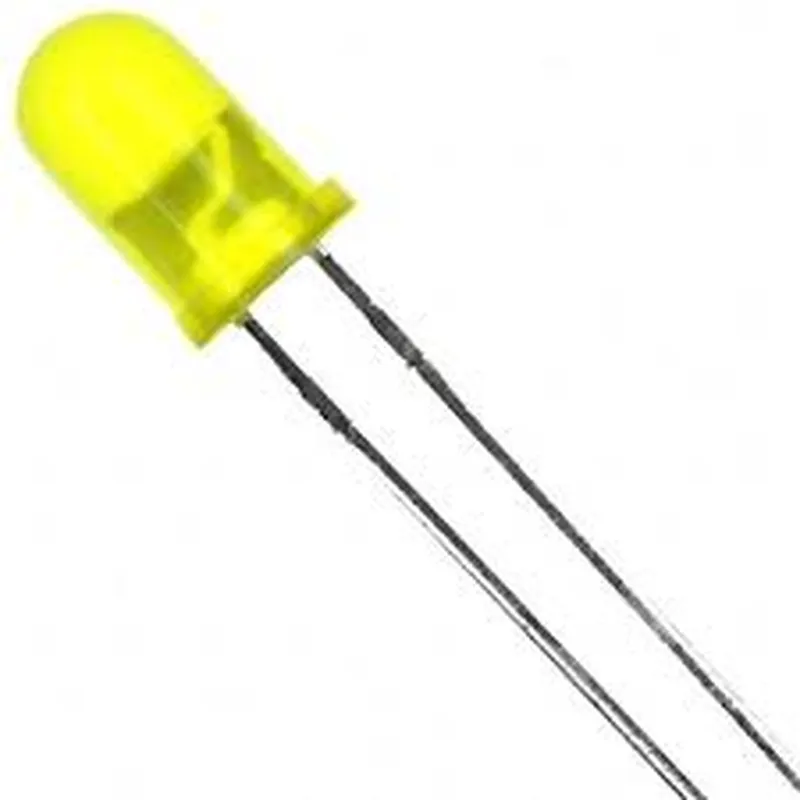
  • The 5mm Yellow LED has two pins, which are:
  • ### Pin 1: Anode (Positive Leg)
  • Function: Connects to the positive voltage source
  • Characteristics:
  • + Longer leg of the LED
  • + Typically denoted by a slight flat edge on the plastic casing
  • + Marked with a "+" sign or a triangle on the component body
  • Electrical Characteristics:
  • + Maximum forward voltage: 2.0V
  • + Maximum forward current: 20mA
  • ### Pin 2: Cathode (Negative Leg)
  • Function: Connects to the negative voltage source or ground
  • Characteristics:
  • + Shorter leg of the LED
  • + Typically denoted by a round edge on the plastic casing
  • + Marked with a "-" sign or a straight line on the component body
  • Electrical Characteristics:
  • + Maximum reverse voltage: 5.0V
  • + Maximum reverse current: 10uA
  • Connecting the Pins:
  • To connect the 5mm Yellow LED, follow these steps:
  • Step 1: Identify the Anode and Cathode
  • Identify the Anode (Positive Leg) by its longer length and flat edge on the plastic casing.
  • Identify the Cathode (Negative Leg) by its shorter length and round edge on the plastic casing.
  • Step 2: Connect the Anode to the Positive Voltage Source
  • Connect the Anode (Positive Leg) to a positive voltage source, such as a power supply or a digital output pin of a microcontroller.
  • Ensure the voltage supply is within the recommended maximum forward voltage of 2.0V.
  • Step 3: Connect the Cathode to the Negative Voltage Source or Ground
  • Connect the Cathode (Negative Leg) to a negative voltage source, such as ground or a digital output pin of a microcontroller configured as an output low.
  • Ensure the voltage supply is within the recommended maximum reverse voltage of 5.0V.
  • Step 4: Add a Current-Limiting Resistor (Optional but Recommended)
  • To prevent the LED from drawing excessive current and to prolong its lifespan, consider adding a current-limiting resistor in series with the LED.
  • Calculate the required resistance value based on the desired current and voltage supply using Ohm's Law.
  • Example Connection Diagram:
  • Here's an example connection diagram for connecting the 5mm Yellow LED to a 5V power supply with a current-limiting resistor:
  • VCC (5V) R (Current-Limiting Resistor, e.g., 1k) Anode (Positive Leg) LED Cathode (Negative Leg) GND
  • Important Safety Notes:
  • Always handle LEDs with care to avoid electrical shock or damage to the component.
  • Ensure the voltage supply is within the recommended operating range to prevent damage to the LED or other components.
  • Avoid reversed polarity connections, as they can damage the LED or other components.

Code Examples

Component Documentation: 5mm Yellow LED (Pack of 10)
Overview
The 5mm Yellow LED is a light-emitting diode (LED) that produces a bright, yellow light when an electric current passes through it. This component is commonly used in various electronic projects, such as indicators, displays, and decorative lighting. This pack includes 10 individual LEDs.
Technical Specifications
Color: Yellow
 Size: 5mm (T1 3/4)
 Forward Voltage: 2.0V
 Forward Current: 20mA
 Luminous Intensity: 100mcd
 Viewing Angle: 60
 Operating Temperature: -20C to 80C
Pinout
The 5mm Yellow LED has two legs:
Anode (Positive): Long leg
 Cathode (Negative): Short leg
Code Examples
### Example 1: Basic LED Connection (Arduino)
In this example, we will connect the 5mm Yellow LED to an Arduino board and blink it at a rate of 1Hz.
Hardware Requirements:
5mm Yellow LED
 Arduino Board (e.g., Arduino Uno)
 220 Resistor
 Breadboard
 Jumper Wires
Software Requirements:
Arduino IDE
Code:
```cpp
const int ledPin = 13;  // Choose a digital pin on the Arduino board
void setup() {
  pinMode(ledPin, OUTPUT);
}
void loop() {
  digitalWrite(ledPin, HIGH);  // Turn the LED on
  delay(1000);              // Wait for 1 second
  digitalWrite(ledPin, LOW);  // Turn the LED off
  delay(1000);              // Wait for 1 second
}
```
### Example 2: LED Driver Circuit (Raspberry Pi)
In this example, we will create a simple LED driver circuit using a Raspberry Pi and the 5mm Yellow LED.
Hardware Requirements:
5mm Yellow LED
 Raspberry Pi (e.g., Raspberry Pi 4)
 220 Resistor
 Breadboard
 Jumper Wires
Software Requirements:
Raspbian OS
Code:
```python
import RPi.GPIO as GPIO
import time
# Set up the GPIO library
GPIO.setmode(GPIO.BCM)
# Set the LED pin as an output
led_pin = 17
GPIO.setup(led_pin, GPIO.OUT)
try:
    while True:
        # Turn the LED on
        GPIO.output(led_pin, GPIO.HIGH)
        time.sleep(1)
        # Turn the LED off
        GPIO.output(led_pin, GPIO.LOW)
        time.sleep(1)
except KeyboardInterrupt:
    # Clean up the GPIO library
    GPIO.cleanup()
```
These examples demonstrate the basic usage of the 5mm Yellow LED in different contexts. You can modify the code to fit your specific project requirements.